The Real Cost of Manual Work in a Corporate Team
Most managers underestimate how much repetitive work is actually happening on their team. The numbers, when calculated properly, are hard to ignore.

Daniel Kubiak
Founder
Management
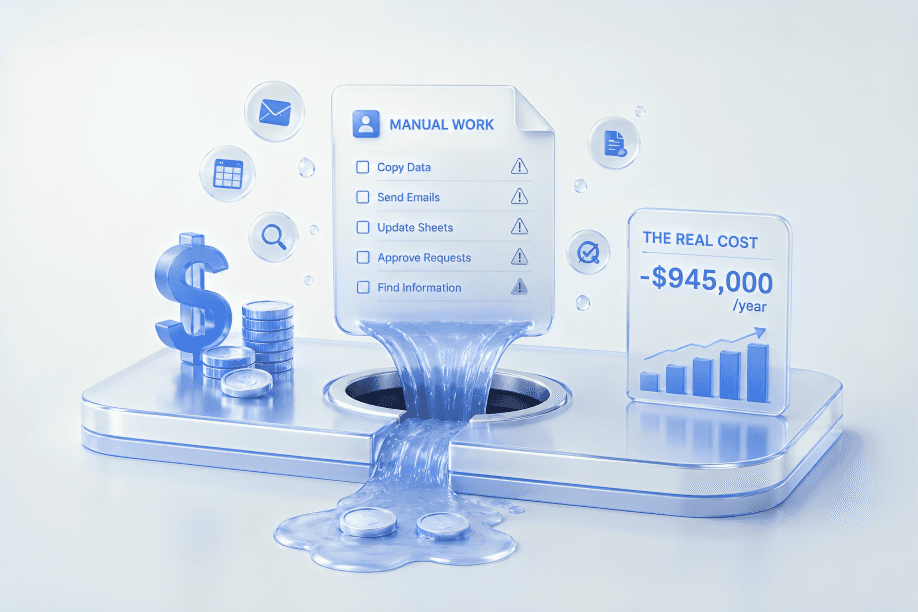
Ask any manager how much time their team spends on
manual, repetitive tasks and the typical answer is
"some, but not that much."
The actual number is almost always higher.
Much higher.
The calculation most companies never do
Take a team of 10 people. Each person spends an average
of 3 hours per week on tasks that could be automated -
data entry, copy-pasting between systems, sending
status update emails, chasing approvals.
3 hours × 10 people = 30 hours per week.
30 hours × 48 working weeks = 1,440 hours per year.
At an average fully-loaded cost of €35 per hour,
that's over €50,000 per year. Spent on work that
adds no value. Work that a properly configured
automation could handle in seconds.
And 3 hours per week is a conservative estimate.
For roles in finance, HR operations, or shared
services, the real number is often 5 to 7 hours.
The hidden costs beyond salary
Time is the obvious cost. But manual work creates
three additional costs that rarely appear in any
budget discussion.
Error cost.
Manual data entry has an average error rate of 1–3%.
In finance and compliance-heavy environments, a single
miskeyed figure can trigger hours of reconciliation work,
audits, or at worst - regulatory consequences.
Attention cost.
Repetitive tasks don't just consume time. They consume
cognitive bandwidth. An employee who spends the first
hour of their day copy-pasting data into a report
is not at their best for the strategic work that follows.
Cognitive fatigue is real, and it compounds.
Retention cost.
High-performing employees leave organisations where
their time is wasted on low-value tasks. Replacing
one mid-level corporate employee costs between 50%
and 200% of their annual salary when recruitment,
onboarding, and lost productivity are factored in.
Manual work is a retention risk.
What the ROI of automation actually looks like
A Power Automate training programme for a team of 10
typically costs a fraction of the annual cost of
the manual work it eliminates.
The first automation - built during training -
usually goes live in week 2 or 3. From that point,
the savings begin compounding immediately.
By month 2, teams are typically operating independently,
building new automations without external support.
The knowledge stays in-house. The savings are permanent.
The uncomfortable question
If you knew a single week of training could save your
team 30 hours every week from that point forward -
permanently, using tools you already pay for -
what would be the justification for not doing it?