Power Automate vs Hiring: What Companies Get Wrong About Scaling
When workload increases, the default answer is headcount. But for a growing category of repetitive tasks, there's a faster, cheaper, and more scalable solution already in place.

Daniel Kubiak
Founder
Insight

When a team's workload grows, the default response
in most organisations is predictable: request a headcount
increase, wait three months for approval, hire someone,
onboard them for six weeks, and hope the problem
is solved by quarter three.
This cycle repeats endlessly. And for some types of work,
it makes complete sense. For others, it's one of the
most expensive mistakes a growing company can make.
Two types of work
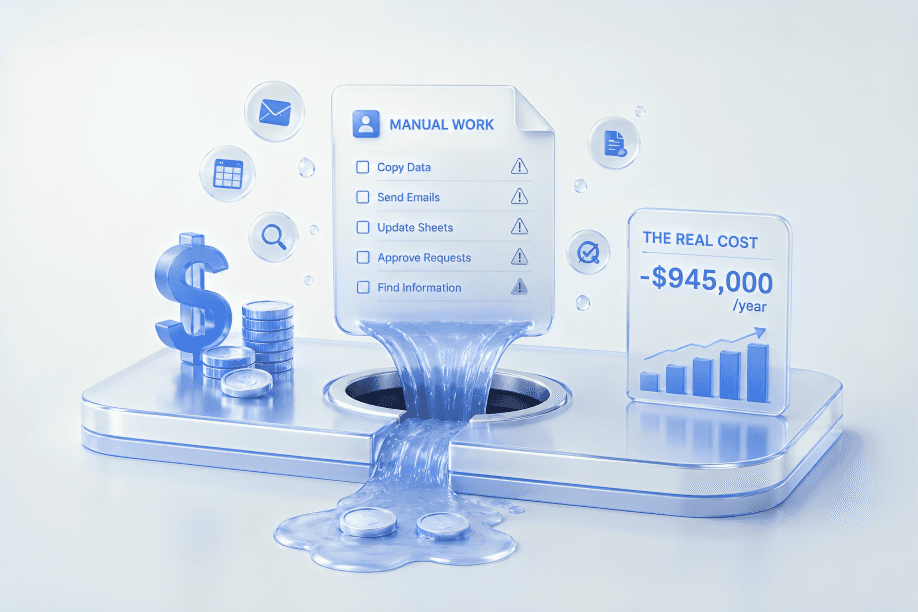
Not all workload is equal. There is work that requires
human judgment - analysis, relationship management,
problem-solving, communication. This work scales
with people. More volume genuinely requires more humans.
Then there is work that requires human execution but
not human judgment. Data entry. Sending routine emails.
Generating reports. Routing approvals. Extracting
information from documents. This work does not scale
with people. It scales with automation.
The problem is that most organisations treat both
types identically. When volume increases, they hire.
What they should be asking first is: is this work
that a person needs to do, or is this work that
a person is currently doing because no one has
automated it yet?
The compounding problem
Here is what makes this mistake expensive over time.
When you hire to solve a manual work problem, you solve
the problem at current volume. You also add a salary,
benefits, management overhead, and a person whose
time will increasingly be consumed by the same
repetitive tasks as volume continues to grow.
When you automate, you solve the problem at current
volume and every future volume. An automation that
processes 50 invoices per day processes 500 per day
without any additional cost or effort.
One solution scales. The other doesn't.
What this looks like in practice
A shared services centre handles vendor onboarding.
As the business grows, onboarding volume doubles.
The team requests two additional FTEs to handle
the increased load.
Alternatively: a Power Automate flow captures
vendor data from an intake form, validates it
against existing records, creates the vendor profile
in the ERP, and sends confirmation - automatically.
The existing team handles twice the volume with no
additional headcount.
This is not a hypothetical. It is the current reality
for teams that have invested in automation capability.
The capability question
The barrier to this outcome is not technology.
Power Automate is already available to most corporate
teams through their Microsoft 365 licence.
The barrier is capability - whether the team knows
how to use the tools they already have.
That is a training problem. And training problems,
unlike headcount problems, have a one-time cost
and a permanent return.